

Japan has been warned that undermining central bank independence could trigger a sharp rise in government bond yields, a risk that is already materializing in its fragile debt market.
At a high-level meeting of Japan’s top economic council, former IMF chief economist Kenneth Rogoff cautioned Prime Minister Sanae Takaichi that maintaining the autonomy of the Bank of Japan (BOJ) is essential to preserve investor confidence and prevent destabilizing increases in borrowing costs, according to official minutes released Wednesday.
The warning comes at a critical moment for Japan’s economy, where bond markets are increasingly sensitive to fiscal expansion and political pressure on monetary policy. Rogoff specifically noted that long-term Japanese government bond (JGB) yields could climb to 3% or higher if global debt-financed spending continues and markets perceive that governments are influencing interest rate decisions.

This concern is not theoretical. Japan’s bond market has already shown signs of stress. The 10-year JGB yield recently reached 2.43%, a 27-year high, reflecting investor unease over rising fiscal spending and policy direction. At the same time, long-term yields have surged even more sharply, with some maturities hitting multi-decade or record highs amid fears of increased borrowing and inflation risks.
The backstory to this tension lies in Japan’s evolving policy mix. Prime Minister Takaichi has promoted expansionary fiscal measures, including fuel subsidies and potential tax relief such as freezing the 8% food sales tax. These policies are intended to support households and growth but risk expanding Japan’s already massive public debt burden.
Japan’s debt is already among the highest globally—around 250% of GDP—making market confidence particularly sensitive to signals of fiscal discipline or lack thereof.
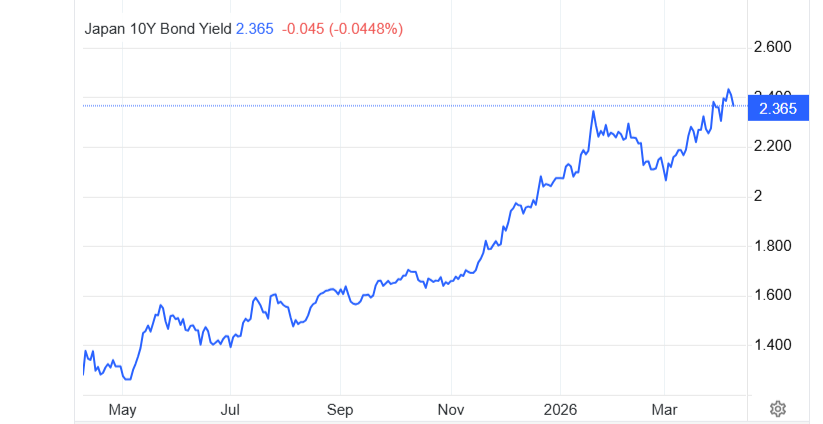
Rogoff’s warning reflects a broader economic principle: when markets believe a central bank is no longer independent, they demand higher yields to compensate for inflation and policy risk. This dynamic increases government borrowing costs and can trigger a negative feedback loop, especially in highly indebted economies.
Other economists at the same meeting reinforced this concern. Olivier Blanchard, former IMF chief economist, reportedly opposed tax cuts and stressed that Japan’s favorable debt dynamics—largely supported by years of ultra-low interest rates—may not last as global rates normalize. He warned that Japan may need to achieve a zero primary budget balance within five years to stabilize its fiscal position.
The Bank of Japan itself is already navigating a delicate transition. After years of ultra-loose monetary policy, it faces pressure to raise interest rates in response to inflation and currency weakness. However, any perception that the government is constraining or influencing these decisions could amplify volatility in both bond and currency markets.

The implications extend beyond Japan. As one of the world’s largest sovereign debt markets, shifts in Japanese yields can spill over into global financial systems, affecting capital flows, exchange rates, and borrowing costs internationally.
Looking ahead, the central question is whether Japan can balance fiscal support with credible monetary independence. If policymakers reinforce the BOJ’s autonomy and present a clear medium-term fiscal plan, market stability could be preserved. However, if political pressure continues to blur the lines between fiscal and monetary policy, rising bond yields may become not just a warning—but a sustained reality.