

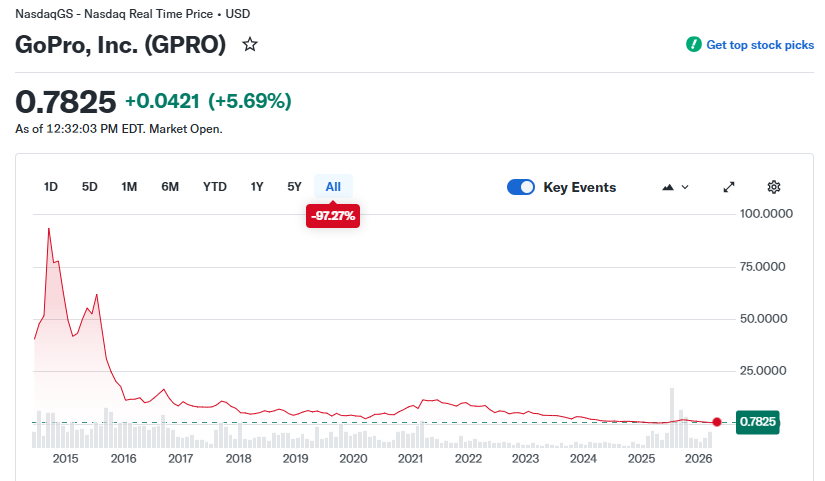
GoPro has announced it will cut roughly 23% of its global workforce—about 145 employees—in a sweeping restructuring aimed at restoring profitability after years of declining sales and intensifying competition.
The move, disclosed in a recent regulatory filing, represents one of the company’s most significant cost-cutting actions in recent years and signals mounting pressure on the once-dominant action camera maker to stabilize its finances and reposition its product strategy.
GoPro’s latest decision comes after a prolonged period of financial strain and shrinking market share. The company, once synonymous with action cameras, has struggled to maintain growth amid competition from rivals such as DJI and Insta360, both of which have expanded aggressively into high-performance and 360-degree imaging devices.
Financial results underscore the challenge. GoPro reported full-year 2025 revenue of $652 million, down nearly 19% year-over-year, while camera unit sales fell about 20% over the same period. Despite efforts to streamline operations—including a 26% reduction in operating expenses—the company still posted a net loss of $93 million for the year.
This is not the first restructuring effort. GoPro previously implemented layoffs in 2024, indicating a broader, ongoing effort to recalibrate its cost base.
The current workforce reduction is part of a formal restructuring plan approved by the company’s board. The layoffs will be carried out during the second quarter of 2026 and are expected to be largely completed by year-end.
GoPro estimates the restructuring will cost between $11.5 million and $15 million, primarily in severance and employee-related expenses. While this creates a short-term financial burden, management is betting that a leaner organization will improve long-term margins and operational efficiency.
The underlying issue is structural: demand for standalone action cameras has softened as smartphones continue to improve video capabilities, while competitors have pushed innovation in stabilization, modularity, and immersive formats. GoPro’s declining sell-through—approximately 2 million cameras in 2025, down 20%—highlights weakening consumer demand in its core segment.
At the same time, the company is attempting to pivot toward higher-end offerings. It plans to launch new cameras powered by its next-generation GP3 processor in 2026, targeting more professional users and premium segments. This suggests a strategic shift away from volume-driven sales toward higher-margin products.

Data and Evidence
- Workforce reduction: ~145 employees, or 23% of staff
- Estimated restructuring cost: up to $15 million
- 2025 revenue: $652 million, down 19% year-over-year
- Net loss: $93 million for 2025
- Camera unit sales decline: ~20% year-over-year
These figures collectively point to a company under sustained financial and competitive pressure, with limited room for incremental fixes.
Conclusion
GoPro’s decision to eliminate nearly a quarter of its workforce marks a critical inflection point. The company is effectively acknowledging that its existing cost structure is unsustainable given current market realities.
Looking ahead, the success of its restructuring will depend on two factors: whether cost reductions can meaningfully improve profitability, and whether its upcoming GP3-powered products can regain relevance in a crowded, innovation-driven market. If the new strategy fails to deliver growth, further restructuring—or even strategic alternatives such as partnerships or acquisition—could become increasingly likely.