

French sugar producer Cristal Union has reported a sharp 14% drop in annual revenue, underscoring a deepening in Europe’s sugar market as prices continue to rapidly.
The company said revenue fell to €2.28 billion for the fiscal year ending January 31, 2026, while a €462 million impairment charge pushed it into a net loss of €442 million—down from a €117 million profit a year earlier. This sudden reversal highlights how quickly market conditions have deteriorated for one of Europe’s key agricultural processors.
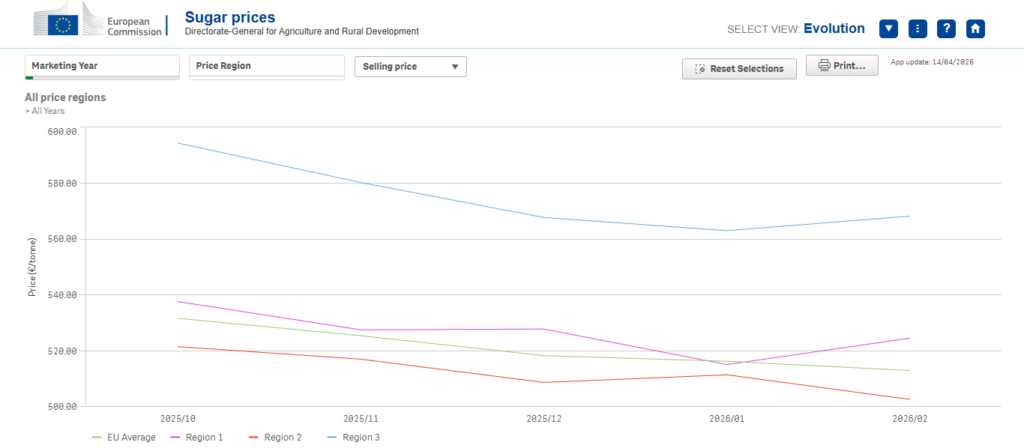
The decline is being driven primarily by collapsing sugar prices across the European Union. Official data shows prices fell to €516 per metric ton in January, marking an 8% drop year-on-year and a steep 40% decline over the past two years. The price slump reflects a broader imbalance in the market, where strong production levels and global oversupply have outpaced demand.
This is not an isolated case. Major industry players such as Suedzucker and Tereos have also reported significant earnings declines and asset impairments in recent months, indicating systemic pressure across Europe’s sugar sector. Analysts point to a combination of high local output, increased imports, and weak global pricing as key factors eroding profitability.

For Cristal Union, the response has been strategic diversification. The company has increasingly shifted focus toward alcohol and ethanol production—segments that offer relatively better margins amid weak sugar pricing. It has also redirected sales toward Mediterranean markets where supply deficits provide more stable demand. This pivot reflects a broader industry trend of reducing reliance on traditional sugar revenues.
Despite current losses, management maintains that the impairment charge does not affect cash flow or investment capacity, signaling that the company remains operationally stable. However, inflation-driven cost pressures—particularly in energy and agriculture—continue to squeeze margins, compounding the impact of falling prices.
Looking ahead, there are early of a potential market correction. European sugar beet cultivation is expected to decline by 4.6% in the 2026/27 crop year, with total planted area projected to fall to a 10-year low of 1.4 million hectares. Reduced supply could push prices back toward €600–650 per ton in the coming months, according to company estimates, although this would still remain well below the €856 peak seen in late 2023.
The broader implication is clear: Europe’s sugar industry is entering a restructuring phase. Producers are being forced to adapt to a lower-price environment, rethink production strategies, and diversify revenue streams. While a partial recovery in prices may offer short-term relief, persistent global oversupply suggests that volatility—and pressure on margins—will remain a defining feature of the market in the near future.