
Nike is on the verge of a major breakthrough in European football after entering exclusive negotiations to become the official match ball supplier for UEFA men’s club competitions from 2027, a move that could end Adidas’s 25-year dominance in the category.
According to UEFA and its commercial joint venture UC3, the proposed agreement would cover all major men’s club competitions—including the Champions League, Europa League, and Conference League—for the 2027–2031 cycle. If finalized, it would mark Nike’s first time supplying match balls for UEFA men’s club tournaments, representing a significant shift in one of football’s most visible commercial partnerships.
The potential deal is not just symbolic but financially substantial. Reports indicate the contract could be worth more than €40 million ($46.7 million) per year, roughly double the value of the current agreement, underscoring UEFA’s strategy to maximize commercial revenue through competitive bidding.
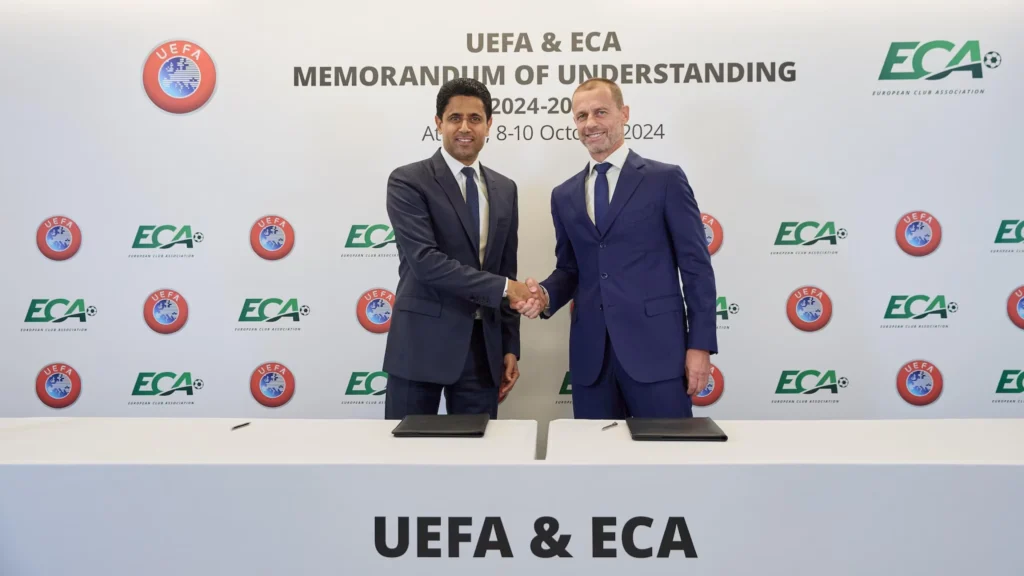
The development follows a formal tender process launched earlier in 2026, when UEFA and the European Club Association opened bidding for the match ball rights starting in the 2027–28 season. This marked the first time in over two decades that the contract was exposed to open competition, attracting interest from major global brands including Nike and Puma.
The backstory highlights the scale of the shift. Adidas has supplied the official match ball for the UEFA Champions League since 2001, becoming synonymous with the competition’s iconic star-panel design. Its current deal runs until 2027, after which UEFA has sought to reassess and potentially monetize the sponsorship more aggressively.
This broader commercial reset reflects UEFA’s evolving strategy. Through UC3, it has increasingly moved toward centralized and competitive sales processes across sponsorship categories, aiming to extract higher value from its global audience. The match ball tender is part of that push, covering a combined schedule of more than 500 matches per season across competitions, making it one of the most visible branding assets in club football.
From a professional standpoint, Nike’s potential entry would reshape the competitive landscape in football equipment sponsorship. While Nike has a strong presence in kits, boots, and global athlete endorsements, it has historically had limited exposure in UEFA men’s match ball supply compared to Adidas. Securing this contract would expand its influence into a highly visible, broadcast-driven asset seen by hundreds of millions of viewers worldwide.
The move also signals intensifying rivalry among major sportswear brands. Adidas, long dominant in ball technology and design at elite competitions, now faces the prospect of losing one of its most iconic partnerships. Meanwhile, Nike’s aggressive bidding—similar to its recent successful bid to supply Germany’s national team from 2027—reflects a broader strategy of using financial strength to capture high-profile football assets.
For UEFA, the implications are primarily financial and strategic. By leveraging competition between global brands, it can significantly increase sponsorship revenue while refreshing commercial partnerships. However, it also risks disrupting long-standing brand associations that have become part of the sport’s identity.
Looking ahead, the outcome of these exclusive talks will determine whether European club football enters a new commercial era. If the deal is finalized, Nike will gain a powerful platform to strengthen its global football footprint, while Adidas may need to recalibrate its strategy to retain influence in other competitions. Regardless of the final outcome, the shift signals a broader trend: football’s commercial ecosystem is becoming more competitive, more centralized, and increasingly driven by high-value global sponsorship battles.