
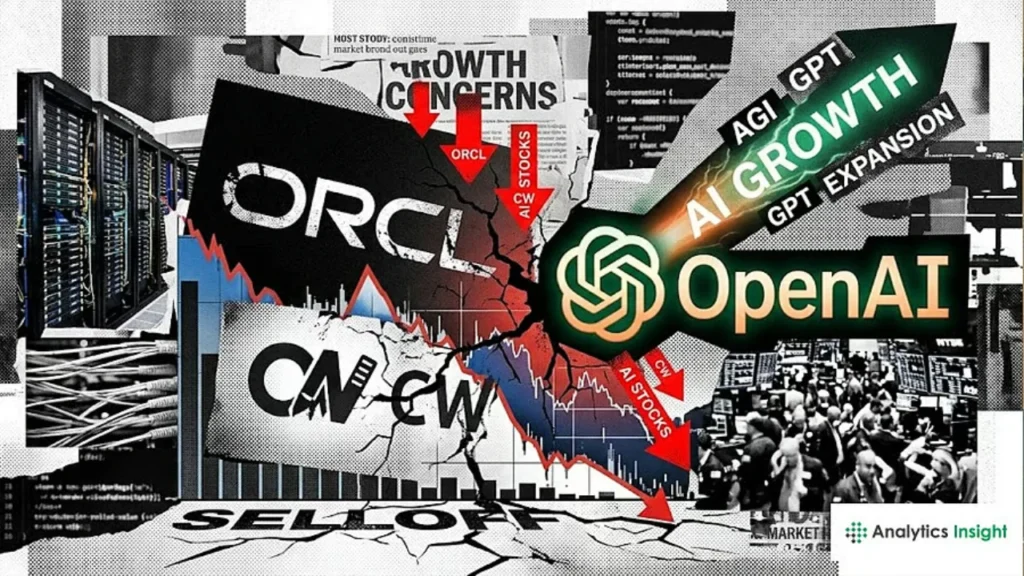
Shares of major artificial intelligence-linked companies, led by Oracle and CoreWeave, fell sharply on April 28 after reports revealed slowing growth at OpenAI, raising fresh doubts about the sustainability of the AI boom. The selloff highlights how tightly investor confidence in the broader AI ecosystem is tied to OpenAI’s performance.
The immediate trigger was a report that OpenAI missed internal targets for both user growth and revenue, prompting concerns from executives about its ability to fund massive future computing commitments. The development sent shockwaves across markets, particularly among companies deeply financially linked to OpenAI’s expansion.
OpenAI has been central to the AI investment narrative, driving demand for cloud infrastructure, chips, and data centers. Over the past two years, firms like Oracle and CoreWeave have positioned themselves as key beneficiaries of this surge, signing multibillion-dollar agreements to supply computing power. However, cracks in OpenAI’s growth trajectory now threaten that entire chain.

The market reaction was immediate and broad. Oracle shares fell as much as 7.7% in premarket trading, reflecting investor anxiety over its reported $300 billion cloud computing deal with OpenAI spread over several years. CoreWeave, which recently signed an $11.9 billion infrastructure agreement with the AI company, saw its stock drop around 7.4%. The selloff extended beyond these two firms, with companies like Arm Holdings and SoftBank—both financially exposed to OpenAI—also posting steep declines.
At the center of investor concern is OpenAI’s cost structure. The company has committed to enormous long-term spending on computing infrastructure, reportedly exceeding hundreds of billions of dollars, while its revenue growth has not kept pace. Chief Financial Officer Sarah Friar has reportedly warned internally that without stronger revenue expansion, the company may struggle to meet these obligations.
There are also signs that competition is intensifying. Rivals such as Google and Anthropic are gaining traction in key areas like enterprise AI and coding tools—segments that generate more stable revenue than consumer-facing products. This raises questions about whether OpenAI can maintain its dominant position long enough to justify the scale of infrastructure investments being made around it.
Despite the selloff, some analysts argue that the broader AI market remains structurally strong. However, the reaction underscores a shift in investor sentiment: markets are becoming less willing to fund large-scale AI expansion purely on future growth expectations. Instead, they are demanding clearer evidence of sustainable revenue and returns.
The implications are significant. Companies like Oracle and CoreWeave are not just technology providers—they are deeply embedded in OpenAI’s growth model. If OpenAI slows its expansion or renegotiates contracts, it could ripple across the entire AI supply chain, affecting chipmakers, cloud providers, and investors alike.
Looking ahead, the key question is whether this selloff represents a temporary correction or the early signs of a broader repricing of AI assets. If OpenAI can stabilize growth and move closer to profitability, confidence may return quickly. But if concerns persist, the market may reassess the valuation of an industry that has, until now, been priced for near-perfect execution.